
Sitting Down with the Tuesday String Band
On a sunny afternoon in mid-May, my photographer Tyler, videographer Matias and I walked with the Tuesday String Band on Main Street in Monmouth, a little town west of Salem and north of Corvallis. We passed the Dry Town Tap Station, a community pub and music venue the band has played over time. The band saw the Western Oregon University’s president sitting outside having a drink. They caught up, told stories, and introduced us. With a school population of roughly 4,000, I guess this seemed about right. “The house band of Monmouth right here!” Dr. Jesse Peters said, endorsing the band.
The Tuesday String Band is a full-time progressive bluegrass trio out of Monmouth, Oregon, working to keep the string band tradition alive in the Pacific Northwest. Having all graduated from Western Oregon University with music degrees, the band, composed of Ryan Hanson (mandolin, vocals), Gage Carter (guitar, vocals), and Mason Akers (stand-up bass) seeks to make music their job through extensive touring and educating the younger generation on the importance of bluegrass and jam music.
Rehearsing every Tuesday afternoon in Gage’s living room, the band jams for a couple hours, crossing off songs for future set lists and planning upcoming shows. They were nice enough to invite Tyler, Matias, and me into their home to sit in on a rehearsal. Between songs, the Tuesday String Band spoke about how they started, the importance of bluegrass, and making music a full-time job.
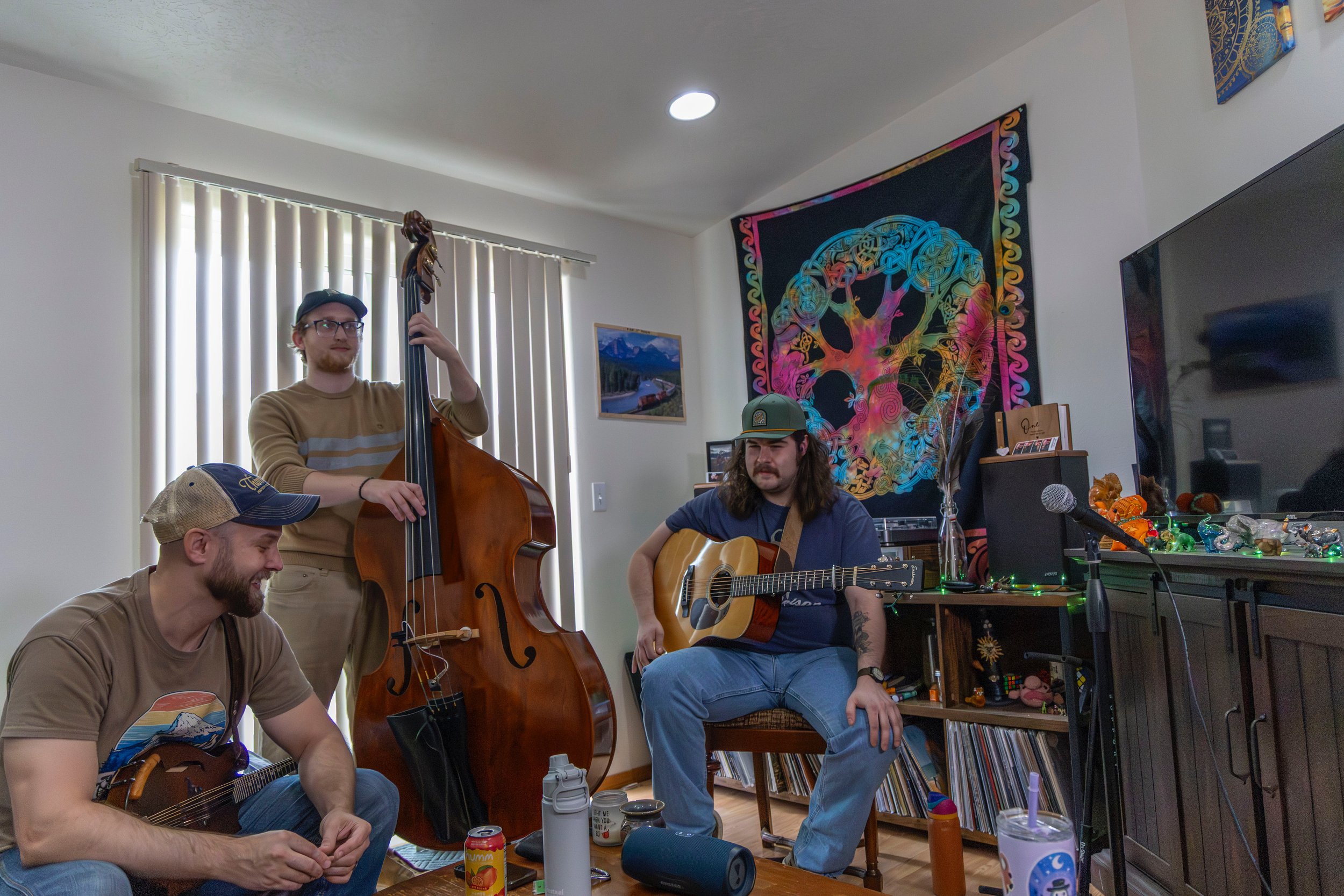
Tuesday String Band photographed by Tyler Fichman
Bluegrass became an idea during the COVID pandemic of 2020, where Ryan and Gage began picking together and decided to start a bluegrass band. Mason, the stand-up bassist, joined the band more recently, after the previous bassist Carson Perl parted ways. After a project on the bluegrass scene in the Pacific Northwest for an ethnomusicology class, Ryan began to fall in love with the genre. “It’s a beautiful thing to witness, seeing a group of people in different stages of life— y’know like kids up to old folks, and they share this tradition of knowing these tunes. It can bring people together from any part of the world,” Ryan said.
Originating in Appalachia, bluegrass grew from the folk music of Irish, Scottish and English immigrants before evolving through jazz and blues influences. “It had jazz influence and lots of blues influence and all these other things which allowed it to separate from the traditional way of playing tunes,” Gage said.
Despite having very different upbringings, all three bandmates cited jazz as a gateway to their musical journeys. Ryan, growing up in Quincy, Illinois, recalled taking on the challenge of the saxophone as early as fourth grade. In Anchorage, Alaska, Gage played sax in his sixth-grade band, with guitar coming shortly after he saved up enough money to buy. Mason, the only Oregon native, played drums and percussion throughout middle school, and then picked up jazz bass at McMinnville High School.
Like jazz, bluegrass is a style of music that is rooted in not just improvisation, but community. “With bluegrass jams, they are welcoming to players of different skill levels. Wherever you go, you’ll be able to find a bluegrass jam somewhere. Whether they’re playing at a grange hall or in someone’s backyard.” – or in this case, Gage’s living room. “That’s how you get connected with your people in that area,” Ryan said.
Ryan, Mason, and Gage have made it a goal to keep the string band tradition alive by all teaching music, but also travelling to elementary schools in an attempt to educate children about why string bands are so important to music and community. “It gets people together in person. That is so huge right now,” Ryan said. Gage chimed in, “It’s a very raw form of music. In the days of technology, people I think are seeking things that are more authentic I guess. Hearing people play acoustic instruments and sing without a bunch of processing or effects… there’s just something so raw about keeping American tradition alive.”
After the band concluded its rehearsal, the members offered a tour of Monmouth, first stopping at the town’s amphitheater. The venue is a popular hub for live music, especially around the Fourth of July, when the band frequently plays. Playing nearly 200 shows in 40 different cities, the Tuesday String Band has found that especially as a band out of a small town in Oregon, “you need to hustle to get your name out there in a grassroots kind of way,” Ryan said. “The hope is that over time, you can become more selective on the gigs that you accept, you know? Like the places that will treat you well and compensate you right versus the places that will be like, “well, we’ll give you a cut of what we made only if you put some butts in the seats for us.”
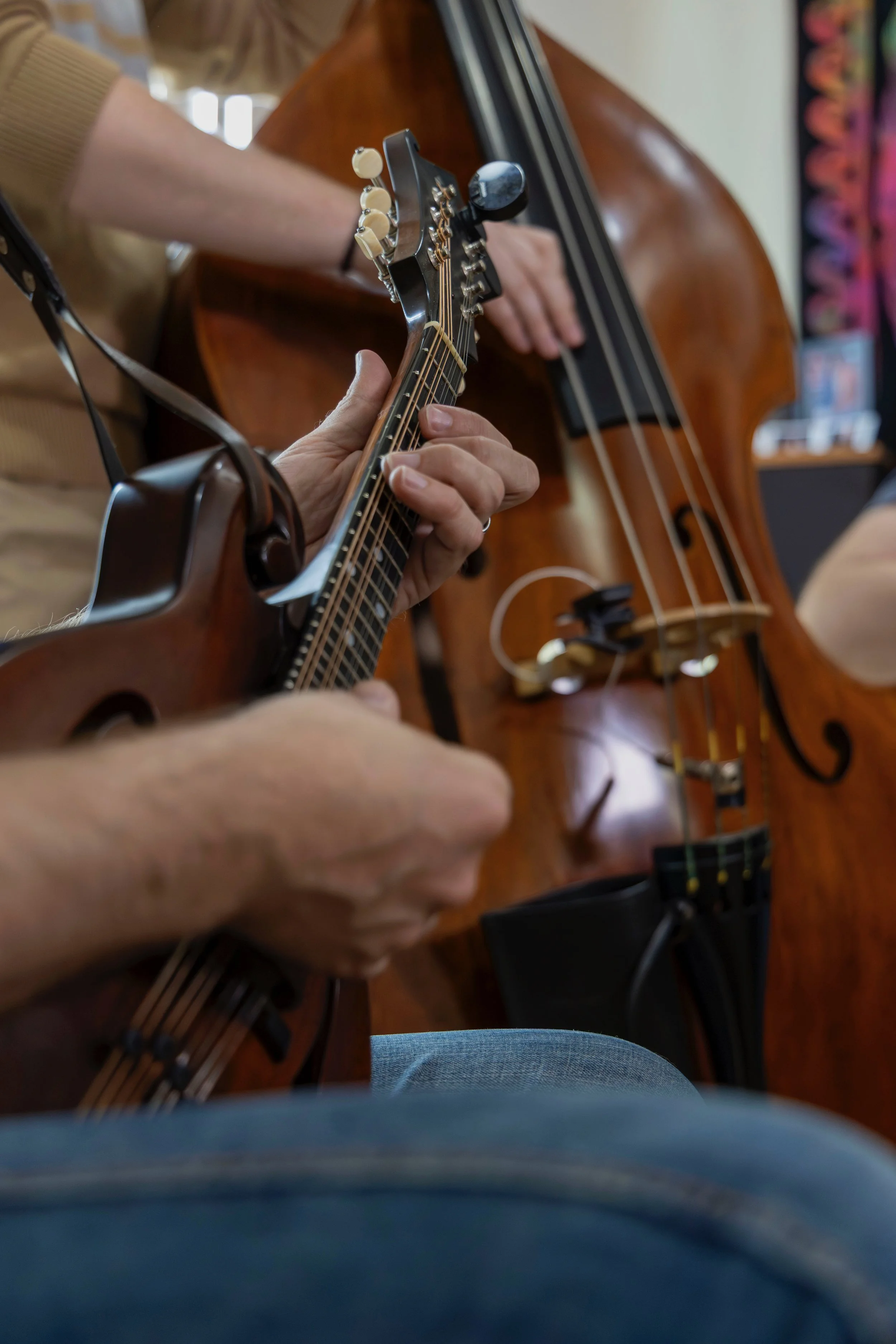
Tuesday String Band photographed by Tyler Fichman
Using social media as a tool to grow is becoming bigger for independent bands as well. More and more bands are using social media algorithms such as Instagram and Tiktok to reach a wider audience, and hoping to have a viral video or two. “We actually had a viral video, and it was a duet kind of thing where we added an instrument to someone else’s video of an instrument. If you look up ‘beans and baloney,’ that’s what it’s called. That got millions of views and our following skyrocketed — at least the numbers did,” Gage, the social media owner, said. “It was a weird thing, though, because those people didn’t stick around for the music and those people weren’t coming out to shows. It’s not like you make money off of social media unless you’re getting tons of views so it’s not like that really made us money. I’m still waiting for the day that somebody comes to a show and says, ‘I found you guys through this ‘beans and baloney’ video!’ Hasn’t happened yet.”
The band walked up Main Street, showing off their favorite food spots and the market and deli, as they headed towards their former Western Oregon University music hall, where the band formerly spent much of their time practicing and recording their music.
An older man ambled by on his bike and stopped to talk with the band. This was Shane– an apparent well-known figure amongst the town of Monmouth.
“Where you going, Shane?” Gage, the trio’s guitarist said.
“Jack’s,” Shane said. Shane, a regular at the town’s bar Jack’s (although he does not drink), provided a very convincing sales pitch to us, selling us each a homemade colorful bookmark for a buck a piece. Shane biked on as Ryan led the group towards campus.
Standing outside Smith Hall, Western Oregon’s music department, the Tuesday String Band recounted the hardships that went into deciding they wanted to make music their full-time job. Ryan, as not only the mandolinist and vocalist, but also the booking manager, explained how prior to establishing yourself as a band, “you just have to send out hundreds and hundreds of inquiries to venues and expect just a small percentage of them will reply… you need to also have thick skin because there are a lot of venues who won’t give you the time of day or put you in the same boat as a local hobbyist, rather than people who invested in getting a music degree, people who wanted to do this full time, and people who are putting in 40 hours a week to try to make this a reality.”
It was heading into late afternoon, and we were deep into discussing all sorts of stuff: future music releases, favorite albums, and how the Melvins went country for a couple songs on their 2000 album ‘Crybaby’. Not only are these guys great musicians and know exactly how to captivate a crowd with their charisma and talent, but they are also great people. Between rehearsals and conversations about Gage’s love for fishing, touring and small-town life, there’s a strong bond between the trio that shows in their musical presence. If you’re in Eugene mid-July, you can experience the Tuesday String Band yourself (location TBD).