
Expression within Suppression: Berlin and Street Art
Once meant to be the “New World Capital: Germania” by Hitler and his Third Reich and later divided after World War II, Berlin is a city marked by tragedy and conflict. Under Nazi rule, it became the center of the Party’s future plans and a site of hate, violence, and forced conformity. The end of the war offered little relief; bombings had devastated infrastructure and morale, the population had declined, and the city had fallen under an oftentimes vengeful Allied occupation. Despite this devastation, Berlin survived. Today it is known for its vibrant club scene, contemporary music and art, and a culture of liberated expression formed after decades of oppression.
In the treaties and the subsequent redivision of territories following the end of World War II, the city of Berlin was split into four sectors by Britain, the United States, France, and the USSR, effectively dividing the city and Germany into “The West” and “The East.” The cultural divide between the two was strong, and rising tensions culminated in the construction of the Berlin Wall in 1961. The wall was erected overnight, dividing the city: half under Western control, the other half under the Eastern Bloc. This was a divide in which both parties would suffer.
It was during this dark point, however, that art became a crux of culture in Berlin. On the East side of the wall, music, journalism, literature, and other forms of artistic expression were strictly monitored by the German Democratic Republic (GDR). On the Western side of the Wall, expression was unmonitored, and as art around the world shifted towards the contemporary and political climates worsened, Berlin became a standout in expressions of unrest.
The divide in the city was unpopular with both sides, and as growing intolerance spread, the Western side of the Wall became a living canvas of protest and resistance. This trend began with Thierry Noir in the early ‘80s, a Frenchman who was less hesitant to desecrate the Wall than wary Berliners. He had to work quickly, using vivid colors and simple lines to avoid possible criminal charges from the GDR enforcers that patrolled both sides of the Wall. This graffiti movement was nearly impossible in East Germany, where coming close to the Wall resulted in death. Seeing Noir’s work inspired a growing sense of boldness, and despite their initial fear and hesitance, graffiti art became a fast-spreading trend across West Berlin.
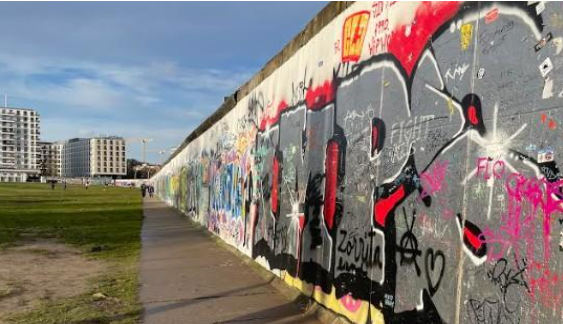
Art along the Wall ranged from the work of Noir, which undermined the seriousness of the Wall, to symbols of freedom like the Statue of Liberty, messages of hope, or vulgar words of displeasure to the GDR. The once daunting wall that represented the silent continuation of a war long since over had become a hodge-podge of joy, anger, and expression.
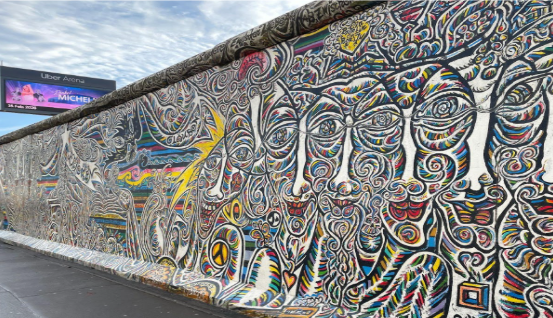
With the increased demands for its demolition, the Wall fell at the hands and hammers of Berliners in 1989, when the GDR announced the opening of the border. Some remains of the Wall still stand throughout the city and have become a reminder not only of the tyranny that once was, but also of the hope and of the human persistence that allowed the Wall to fall.
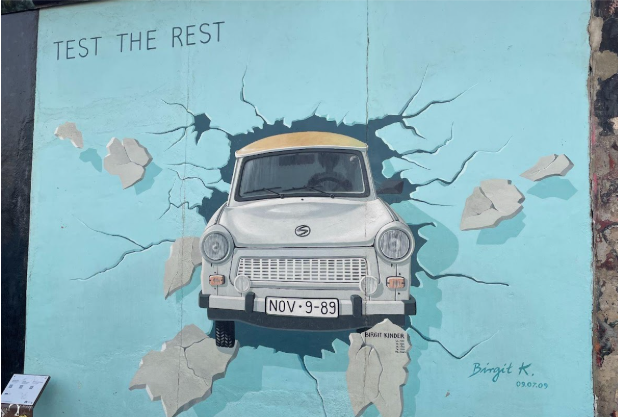
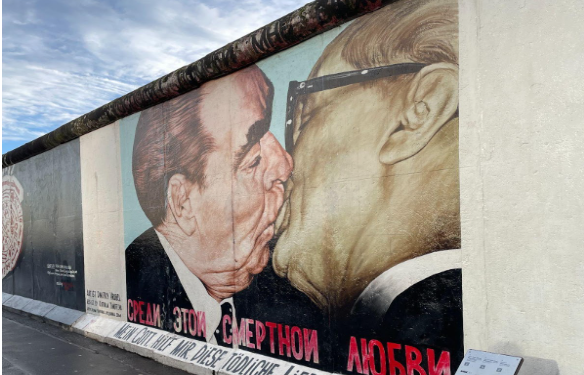
In a now united Germany, a section of the East side of the Wall, the East Side Gallery, was dedicated entirely to murals. The stretch of wall is 4,318 feet long and houses 105 murals by artists from 21 different countries. The project was unveiled in 1990, and subsequently, the art is largely political commentary on the changes in Berlin and the wider world during the thawing of the Cold War. Most famously, the East Side Gallery is home to the Fraternal Kiss by Dimitri Vruel. This work is a recreation of the iconic photo taken on the 30th anniversary of the GDR depicting a celebratory kiss between a German and a Soviet political leader. The piece is satirical, with irony in the coming together of the two men, whose creation worked only to divide, and in their breakup, now immortalized in their failed project. Other pieces celebrate the escapees and memorialize those who lost their lives in an attempt to flee. One such piece, Trabant Breaks Through the Berlin Wall, depicts a car ripping through the Wall's defenses, a real escape technique used by East Berliners.
This celebration of art in public spaces continues throughout Berlin, as seen in places like the North Side Gallery, a section of the city now open for street art. The space is dedicated to graffiti, and artists are encouraged to come together and paint over one another in droves. The Graffiti Lobby of Berlin argues that it keeps the area clean, advocates for the respect and preservation of other historic sites, and creates a public, accessible space for displays of modern art and artists.
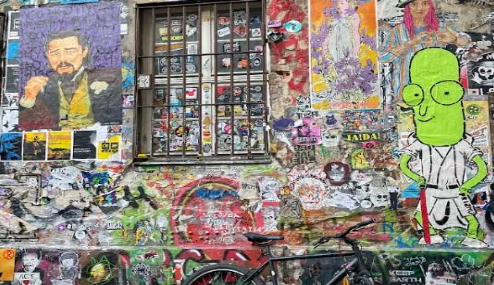
Private spaces in Berlin follow a similar pattern, embracing chaotic forms of art across their own walls. A popular tourist and artist destination is Haus Schwarzenberg. The building itself is a historic site, as much of Berlin is, but it is now one coated in layers of paint inside and out. This continues in the alleyway, similarly covered in graffiti. The alley is home to both historic museums and entertainment sites; in response, the art ranges from bright depictions of actors to memorials for those lost in the war's tragedies.
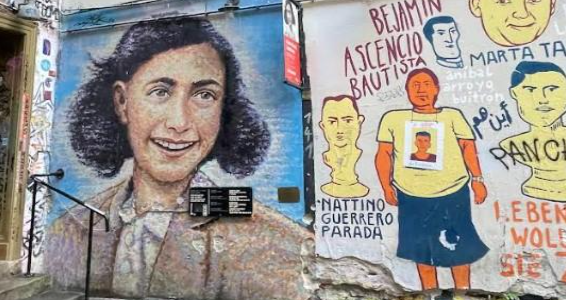
After the tragedies brought about by World War II, countries all over the world began to evolve and change. Berlin, a city with a history more haunting than most, shifted towards art. Covered in contemporary art, graffiti, murals, and a renewed interest in all things art, the city is now covered in expressions of freedom once suppressed. This embrace has changed the city of Berlin, once a stark place of grief, cruelty, and fascism, into a unique place intertwined with memorials, cultural celebration, and art, weaving a web of history, protest, modernity, and remembrance.
About the Author:
Stella Van Goor is a Junior studying Art History and Humanities. She is from Newberg Oregon. Stella loves comic books, Star Wars, Game of Thrones, and spends her free time watching too many TV shows and movies.
Cover Photo: The Game Magazine
Photos Imbedded: Stella Van Goor, December 2025
Sources:
The MIT Press Reader: Hitler’s Noxious Plan to ‘Restructure’ Berlin
Deutchland.de: The GDR - What Life was like for People in East Germany from 1949 to 1990
Wikipedia: The East Side Gallery