
Live Through This: An Ode to Hole’s Sophomore Album and the Woman Behind It
There are many different reports of when the word “grunge” was used to describe a new type of alternative music that arose from the depths of the Pacific Northwest. Specifically, from towns like Olympia, Aberdeen, and most notably Seattle, which is now considered the birthplace of the grunge subculture. This particular type of alternative music emerged from the blue-collar environment of upper West Coast logging towns, coastal fisheries, and airplane factories, as local musicians responded to the seclusion of their gloomy surroundings and created a new type of sound, distancing themselves from the outside world.
In the early 1990s, bands such as Temple of the Dog, Pearl Jam, Nirvana, and Soundgarden released four albums within a six-month period. These four albums launched grunge culture into the stratosphere with a wall of sound that upended the music charts and revitalized an immobile concert ticket market. In the fall of 1991, grunge exploded into the mainstream when Nirvana performed their now most popular song, “Smells Like Teen Spirit,” on MTV, catapulting them into stardom. Now, Nirvana is seen as the quintessential embodiment of the grunge music genre, with Kurt Cobain as a figurehead of alternative rock as a whole.
Cobain's tragic death at such a young age cemented him as a visionary, an almost Christ-like figure in Rock’n’Roll. However, what he is also dually known for is his intense, tumultuous relationship with fellow singer and polarizing figure Courtney Love. Born Courtney Michelle Harrison on July 6th, 1964, in San Francisco, Love underwent an intensely unstable childhood and was brought to live on a commune with her mother after her father had allegedly given her LSD when she was 4. By the time she was 14, she had been expelled from school and arrested for shoplifting, and was subsequently placed in foster care until she was legally emancipated in 1980. After her emancipation, she spent a few years abroad, working as a sex worker in Japan, Taiwan, and Hong Kong, during which she adopted the last name “Love” to conceal her identity. After receiving a small trust fund that had been left by her maternal grandparents, she used the money to fund her education at Trinity College in Dublin. She spent a considerable amount of time following bands in Liverpool and London.
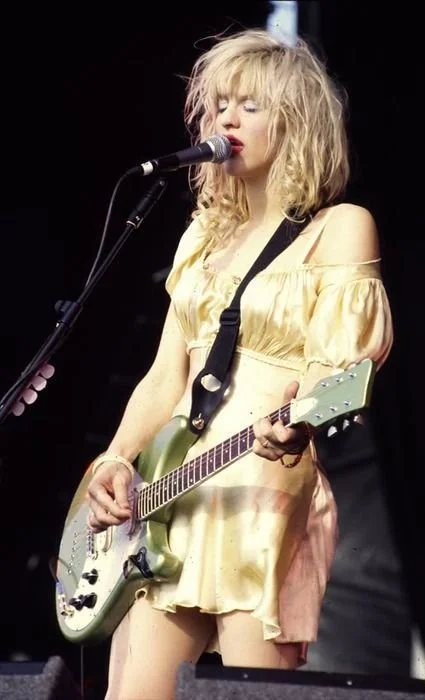
In 1982, Love returned to the U.S. and, in the mid-1980s, formed her first short-lived musical projects, experimenting with punk and alternative rock. In late 1988, Love taught herself to play guitar and moved to Los Angeles, where she advertised in a local music magazine about starting a band. In 1989, she recruited guitarist Eric Erlandson, bassist Lisa Roberts (later replaced by Kristen Pfaff), and drummer Caroline Rue. She named the band “Hole,” after a line from Euripides' Medea ("There is a hole that pierces right through me"), and a conversation she had with her mother, in which she told her that she could not live her life "with a hole running through her" just because she had a bad childhood.
Their debut album, Pretty on the Inside, made waves in the underground community. Shortly after completing the tour for Pretty on the Inside, Love married Cobain on Waikiki Beach on February 24, 1992. She donned a satin and lace dress previously worn by actress Frances Farmer, while Cobain wore checkered pajamas.
Hole’s album Live Through This displayed the band's raw, primal energy while being tightly constructed around Love's emotional ferocity. Recorded in late 1993, it shifted away from the band's raw hardcore aesthetics and toward more refined melodies and song structures. Love stated that she intended the record to be "shocking to the people who think that we don't have a soft edge" while simultaneously maintaining a sharp sensibility. The album was released just days after Kurt Cobain's death, and two months later, the band's bassist, Kristen Pfaff, died of a drug overdose.
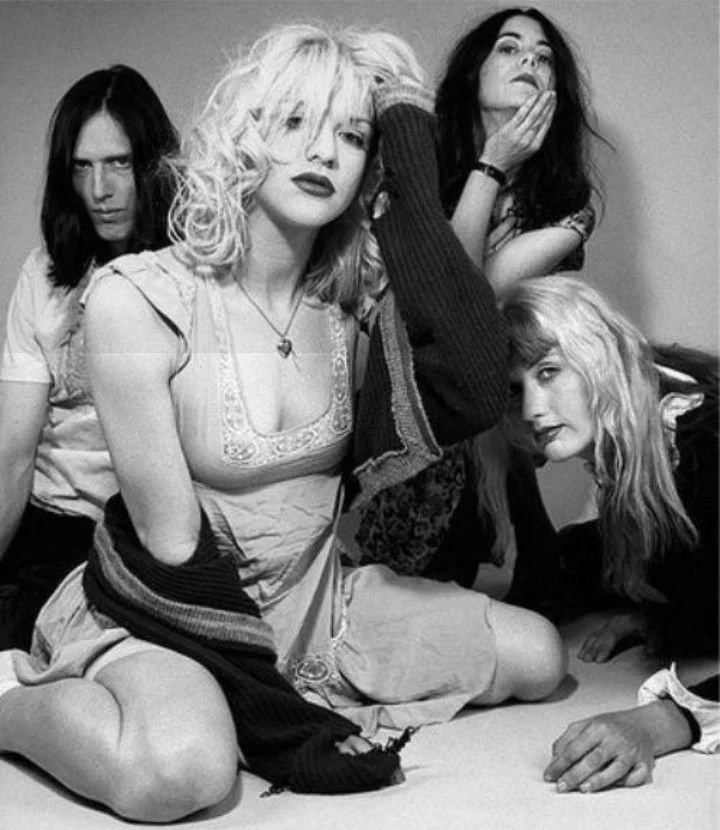
The album featured raw and honest lyrics, reflecting Love’s preoccupations with beauty, motherhood, post-partum depression, anti-establishment sentiments, and violence against women. The album's title comes from a line in the song "Asking For It," which alludes to the commonly used response in instances of sexual assault. While never confirmed, the song is alleged to have been inspired by an incident in which Love was attacked and had her clothes torn off by a crowd after stage-diving during a 1991 tour with the band Mudhoney. The same can be said about the song "I Think That I Would Die," which references the custody battle she and her late husband had undergone with their child, Frances Bean Cobain.
The opening song, "Violet," is filled with contradictions, with Love criticizing the sexually exploitative nature of intimate relationships while simultaneously permitting it on herself: "Well, they get what they want, and they never want it again/Go on, take everything, take everything, I want you to." In "Miss World," and along with every other song, Love addresses the listener directly, not necessarily as the perpetrator of all these problems, but as complicit in society's patriarchal culture. The song begins delicately melodious before erupting into a chorus that repeats itself until it almost becomes an incantation. The cover of Live Through This features a disheveled Miss World beauty queen, and alludes to the album's themes of desire, shame, fame, and survival. Every aspect of her performance was an extension of her songwriting, from her purposely makeup-smeared face to her torn babydoll dresses. The lyrics and imagery for "Doll Parts," as well as the accompanying video, show Love recognizing society's perception of women as objects but still yearning to be one.

In many ways, "Live Through This" is a profoundly cathartic album. Love's anguish is palpable, but so is her refusal to be a victim and her determination to survive. The raw material may be messy, but the completed product is a polished illustration of '90s alt-rock at its core.
Sources
Azerrad, M. (2018, December 27). Grunge City: The Seattle scene. Rolling Stone. https://www.rollingstone.com/music/music-news/grunge-city-the-seattle-scene-250071/ Hopper, J. (2015, March 31). You Will Ache Like I Ache: The Oral History of Hole’s ‘Live Through This’ SPIN.
https://www.spin.com/2014/04/you-will-ache-like-i-ache-the-oral-history-of-holes-live-th rough-this/
Stafford, P. E. (2018). The Grunge effect: music, fashion, and the media during the rise of grunge culture in the early 1990s. M/C Journal, 21(5). https://doi.org/10.5204/mcj.1471 Stavropoulos, L. (2025, September 29). How Hole had their cake and ate it too with ‘Live Through This.’ uDiscover Music
https://www.udiscovermusic.com/stories/live-through-this-hole-courtney-love/
About the Author: Frankie Little is a Sophomore Journalism major at the University of Oregon. They are originally from Los Angeles, California. They are a September Virgo (big difference from August Virgos), and their favorite season is autumn. In their free time, they enjoy writing poetry, playing The New York Times games, and rewatching the best television show of all time: The Sopranos.