
Punk has long existed as the genre of music that exists to fight against both the norms of music and simultaneously the social and political systems of our society. Despite being such a progressive genre in terms of breaking barriers however, punk has also had a history of discriminating against minorities most harmed by the system punk is supposed to reject. As a result, subgenres of punk have emerged to rectify any exclusion that exists. One subgenre in particular, Riot Grrrl, my personal saving grace, is kind of the ideal embodiment of the belief and spirit of punk. Riot Grrrl emerged in the Pacific Northwest in the 1990s, with Olympia, Washington being the main heart of the movement. Spearheaded by all-girl bands, Riot Grrrl created activism and musical communities centered around creating a place for women in punk, and a place to discuss large political and social issues of the time in designated safe spaces. Among the most notable bands to emerge from and create this movement, were Bikini Kill, The Gits, Sleater-Kinney, and Bratmobile.
Lead singer Allison Wolfe and drummer Molly Neuman of Bratmobile met at the University of Oregon before joining Riot Grrrl in the fall of 1989. Bratmobile was the band that introduced me to Riot Grrrl as a movement when I first heard their music in seventh grade. So when I recently had the chance to discuss the formation of Bratmbile at U of O with Allison Wolfe herself, the absolute disbelief and awe I felt was surreal.
1989 Eugene, Oregon was existing alongside the rest of the world in very politically relevant times. The movie Do The Right Thing had just come out, as well as Public Enemy’s, “Fight the Power.” In the midst of domestic social changes, the Gulf War was occurring, and Wolfe remembered that the government was threatening to start the draft. Additionally, the University of Oregon was among the first Universities in the U.S to ban Coca-Cola from campus to boycott the company's complicity in the Apartheid of South Africa, according to Wolfe.
In spite of this, 1989 U of O was still progressing, and still faced large issues of sexism, racism, and homophobia. A right-leaning magazine on campus called “the Oregon Commentator” amplified many issues of hate on campus. In particular, Wolfe recalled, “I remember seeing a cover once where they had like a drawing of people from various marginalized groups and I swear, either a gallows or a noose waiting for them.” Unfortunately, these kinds of actions were not out of the ordinary in early ‘90s Eugene, as Wolfe recalled similar occurrences around town. “I remember one time Molly and I walking around town and seeing pictures, a photocopy that someone had made, it was a picture of a Black woman with a bullseye across her face… And that was posted around telephone poles in town.” Similar to today, Eugene “at the time was the kind of place that was filled with super lefty hippies but also this kind of right-wing, conservative thing…it was that weird merging of polar opposites.”
When speaking of her political influences growing up, Wolfe compared how Molly Neuman had grown up around politics in a more national scale, coming from Washington D.C, whereas Wolfe grew up in small-town feeling Olympia, Washington; “My mom started the first women's health clinic in Olympia, Washington, and she was a really out, butch lesbian, feminist, and kind of always going to bat for women, and queers, LGBTQ people, and also just anyone who was marginalized in our hometown; and of course was always getting attacked for providing abortions… I’d definitely grown up politicized, but maybe more in a small town kind of way, where ‘yeah! Most of the people I saw were cool!’ and the town was kind of run by women in a lot of ways…so when I went away to school, it was kind of interesting to meet someone who kind of had seen politics on a more national scale.”
The merging of attending U of O with her upbringing in Olympia had a sort of perfect combination. Wolfe shared many sentiments about loving her time in Eugene at U of O, in particular saying, “I took really awesome, super lefty classes that were really instrumental in changing my mindframe, or just influencing me.”
Wolfe and Neuman first met as freshmen in the fall of 1989. The two of them both lived in the international dorm (which I believe was Hamilton Hall, as best as I can trace it) and were neighbors. Describing the first time they met, Wolfe said, “I remember the first time I noticed her, she was on the payphone; so this is back during landlines, and there was actually only one payphone in the hallway of each floor of the dorms; and she was hogging up the phone. She was on it for at least an hour I think, just yelling at some guy, clearly breaking up on the phone, and I was like ‘woah that girl’s scary’ and so we became fast friends.”
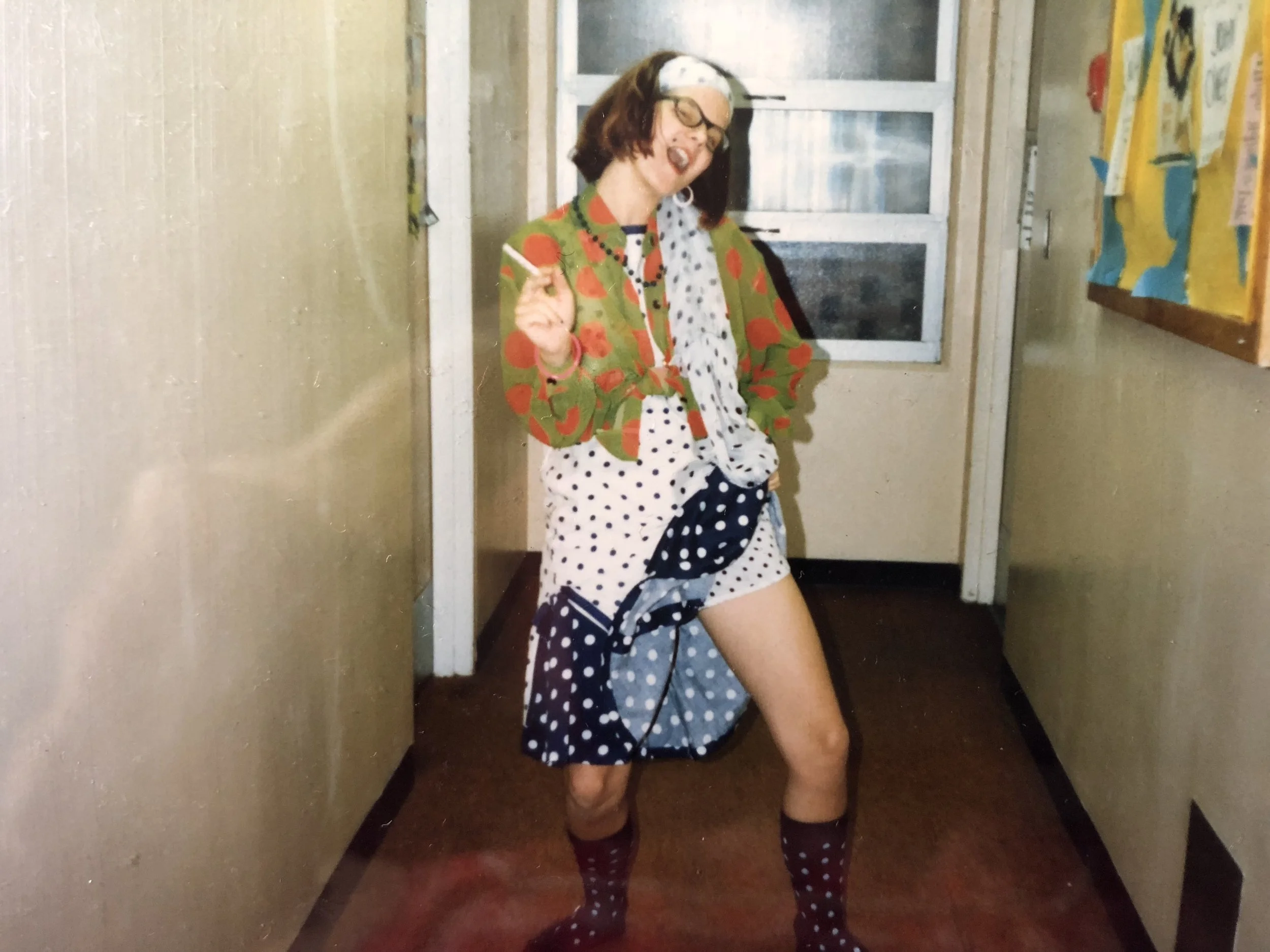
“This is in the hallway of our dorm just before going to the Pixies/Bob Mould show on campus, Halloween 1989. I was dressed as "Polka Dot" or something ha.”
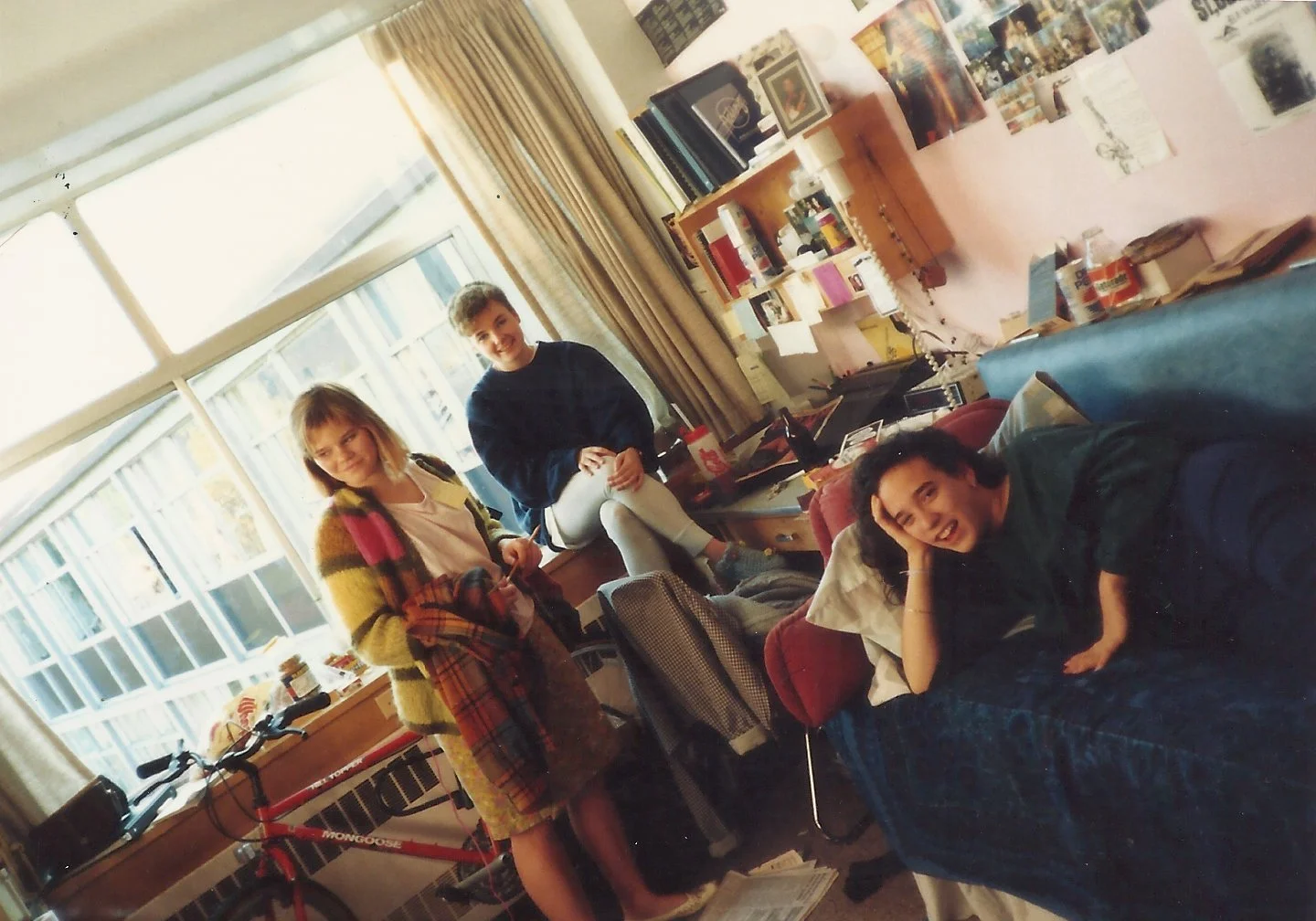
“L-R: My friend Dana Younkins from high school era in Olympia who was visiting us (later was in a band called CWA in Oly), can't remember the other girl's name, but she lived in our dorm down the hall, and Molly Neuman is on the couch. I think this is Molly's dorm room.”
The two shared a wall, and came up with special knocks to tell the other to meet them in the bathroom. Wolfe said that the two would sit on the countertops of the bathroom, with their notebooks and homework, and just talk and hang out. The two began to take women’s studies classes together, and would bike everywhere. Wolfe said one thing she loved was “we used to ride our bikes up there [to Springfield] to like old diners and sit around and eat pie and stuff.”
“But in the end, we moved into this amazing, beautiful, old old 1920s apartment building, right at Willamette and 13th…it was a one bedroom, so Molly got the bedroom, and I lived on the Murphy bed that came out of the wall. And the Murphy bed would turn around into this closet, and that closet was like my room. I somehow managed to fit a little desk in there, and my clothes, so I could do my homework in there.”
On campus, the two were avidly involved in the student community, and got to know many of the student groups at UO; “We were always hanging out at the EMU, always. And I think it was an important time where there were a lot of cool student union groups like the LGBTQ center, and also the Black Student Union, and all these different groups, and we just kind of hung out with everyone in there. And there was one person who was really instrumental, who we met, named Eric Ward…and back then he was co-president of the Black Student Union, and the Students Against Apartheid.”
Along with their student union groups on campus, Wolfe also applied to a job to book concerts on campus. However, after not getting the job, she told me that, “I was bummed …and he was like [the person who got the job] ‘that’s cool you can work with me’…And I tried to work with him; and I remember telling him that I thought maybe I could get Nirvana to come down… Cause they lived in Olympia, we knew them, and they weren’t big yet. So it must have been early on, like 1990 or something…they were big enough, but they weren’t nationwide, they were for sure just Northwest. So I was like, ‘I bet we could get Nirvana to come down,’ and this guy…he said to me that he didn’t think they were a big enough draw.” Imagine saying no to a Nirvana concert on campus!
While at U of O, Wolfe and Neuman went up to Olympia about one weekend a month, where they started connecting with Kathleen Hanna and Tobi Vail of Bikini Kill. The two had heavy connections with the punk scene and Riot Grrrl; with lots of intersecting paths, such as Tobi Vail having lived in Eugene earlier, and connections with Nirvana.
Talks of feminist issues were the main starting point for much of the Riot Grrrl movement, many of which were influenced by the Women’s Studies classes Wolfe and Neuman took together at UO; “A big part of Riot Grrrl was first of all, to make our punk rock world more feminist, but also to make academic feminism kind of more punk… like hey let’s reclaim this! And we can use reclaimed words, and terminology, and that's why we can write slut on our stomach, and we can use words like slut, bitch, girl, whatever, and it’s a reclamation and it’s okay.”
Emphasizing feminist language and vocabulary, Riot Grrrl came to be a more inclusive idea of what feminism could be at the time; “Hey, we’re still teenagers, we’re girls, and by the way, why can’t girls be feminists too, or why can’t they be considered and validated, and why do we have to be like one of the guys to be taken seriously, or even like grown women…feminism should be for everyone including young girls.” This language evolved to also include sex-positive, sex-worker positive, body-positive, sexuality positive, and more types of language and community.
Bratmobile culminated over time as Wolfe and Neuman got more involved with punk communities, traveling between the two of their hometowns. Wolfe remembered, “I would go with Molly to spring break, to Washington D.C, and that’s where we started connecting with like Fugazi, Nation of Ulysses and all these people there, in the punk scene there; and there became kind of a real Olympia, Washington D.C connection of punks.” The constant mobility between the two’s hometowns allowed them to create connections within the punk world, where they began establishing themselves as a band; “We actually talked about Bratmobile, and named the band, as early as the winter of ‘89. But we didn’t play our first show until Valentines Day, 1991, in Olympia, and that was opening for Bikini Kill…We were going up to Olympia a lot and just saying that we were a band, not really doing much about it. We started a fanzine first, while we were still in Eugene; Girl Germs.”
The community in Olympia, as well as the history of unconventional bands, really rallied together to play a supporting role in Riot Grrrl’s growth, as well as Bratmobile’s. From snail mail, to exchanging zines with each other (zine culture played a huge role in Riot Grrrl as a movement), community meetings, and concerts, Riot Grrrl functioned as a community movement as a whole, empowering and building each other up.
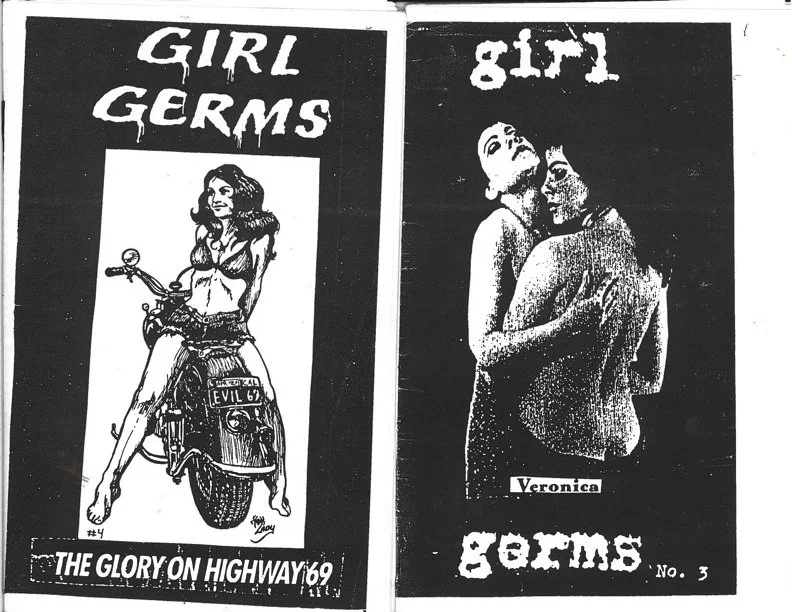
Covers of the third and fourth issues of Girl Germs zine.
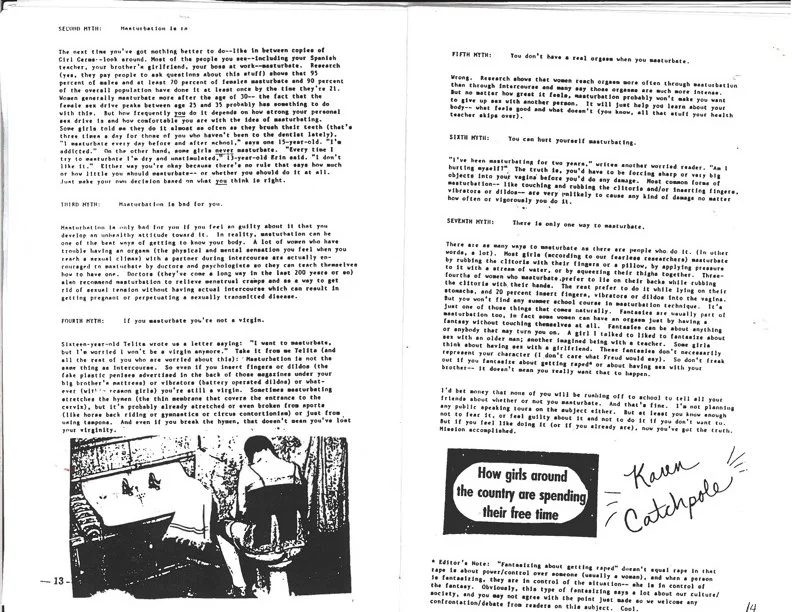
Discussing myths of masturbation, from Girl Germs #3.

The story of Girl Germs and how Molly and Allison met, from Girl Germs #3.
As Bratmobile’s formation gained more traction and came to life, Erin Smith joined as the guitarist, with Molly Neuman switching to drums. “She was a guitar player who had taken lessons, she knew what she was doing,” remembered Wolfe about when Smith joined the band.
Of course the rest is history; Riot Grrrl grew across the Pacific Northwest and still exists in its own form today across the world as it grows and evolves. Today, both Wolfe and Neuman live in L.A. Wolfe currently teaches Music Journalism at UCLA, Neuman is president of CD Baby (within Downtown Music), and Bratmobile has started occasionally playing shows in summer since they reformed in 2023. Wolfe said that they hope to play more shows in the future, and that they’ll announce more soon.