
Tracy Chapman is one of those artists whose names carry an immense amount of weight, even if listeners can't always place a specific song. The legacy that she had created doesn't need constant radio rotation or tabloid headlines. Her legacy is often woven into the fabric of popular music since 1988, when she burst onto the scene with "Fast Car", which was a defining track for her debut album. Chapman was born in Cleveland, Ohio, in March of 1964, and was raised by a single mother who had nurtured her love of music. Chapman was something of a prodigy from the start. By age 8, she was already playing guitar and writing songs, a creative restlessness that eventually led her to the steps of Tufts University, where she studied as an undergraduate, busking for anyone willing to stop and listen in local spots.
What followed was a career that quietly accumulated one milestone after another across her discography. Chapman earned 11 major awards, including four Grammys, two BRIT Awards, an American Music Award, a CMA award, a Billboard Music Award, and honors from both Denmark and the Edison Awards. Her output has spanned over two decades, with her final studio album arriving back in 2008. But one of the truest forms of impact that Chapman had left was what was said by other artists that she had shaped. Khalid named her as the first artist that came to mind when asked about his biggest musical inspiration, praising the way her songwriting puts you right inside the moment. Alicia Keys, John Legend, and Ed Sheeran have all cited her as a major influence, and Beyoncé has acknowledged the role Chapman played as a trailblazer in paving the way for artists who refused to separate their art from their convictions. Another person who has spoken highly of Tracy Chapman was Lisa Marie Presley. Presley had once told Rolling Stone India that Chapman had "always been a huge influence" on her, even though the two had never met; she had always held Chapman at a high and well-regarded standard within the music industry. Folk-soul artist Valerie June, who grew up in Jackson, Tennessee, has spoken openly about how Chapman made her believe a music career was possible when she had all but given up on the idea. The reach doesn't stop at folk or Americana either — artists like Lauryn Hill and Hozier have cited Chapman as a defining influence, a testament to just how far beyond genre her voice travels.
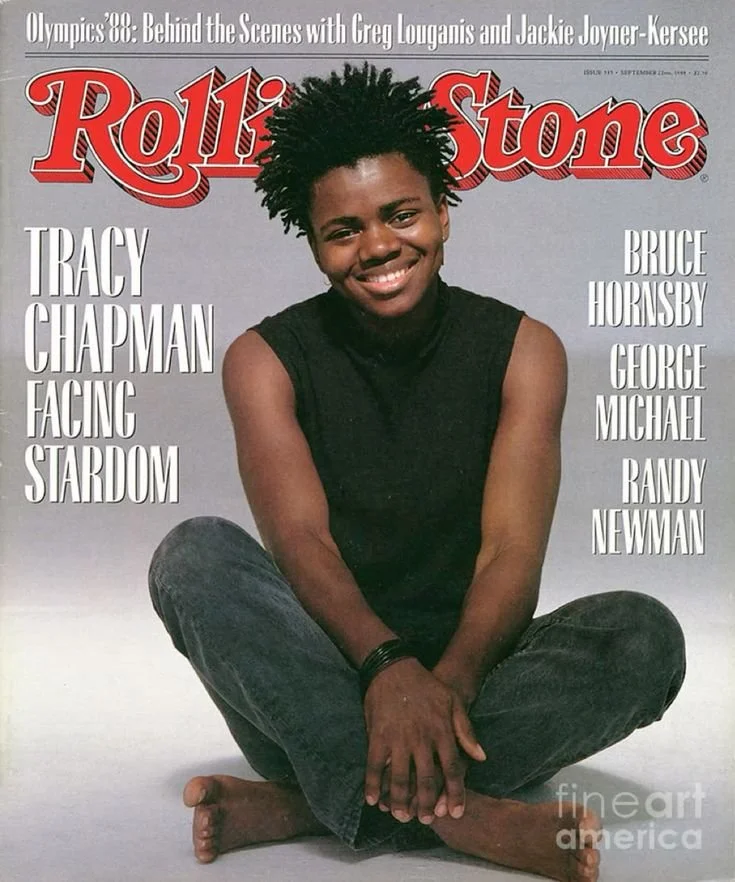
Tracy Chapman featured on the Rolling Stones in 1988
But perhaps her most remarkable chapter came long after many assumed her story was already written. In 2023, country artist Luke Combs covered Fast Car, sending it to number one on the Country Airplay chart — making Chapman the first Black woman to hold a solo writing credit on a number one country song. Then in 2024, she made a rare and electrifying public appearance at the Grammy Awards, taking the stage with Combs to perform the song herself. The crowd was on its feet before she played a single note.
What makes Chapman's story all the more revolutionary in some ways, as well as extraordinary, was how unlikely it once seemed. There was no industry connection waiting in the wings in her early days, no carefully managed debut — just a young girl from Cleveland with a guitar, a notebook, and something urgent to say. She found her audience one listener at a time, on street corners and university grounds, before the world caught up to what she already knew. And even after it did, she never let the machinery of fame reshape who she was. In an industry that rewards oversharing and constant visibility, Chapman has remained one of music's most quietly guarded figures — offering her truth through her songs while keeping the rest entirely her own. No scandal, no spectacle, just the work. It's a philosophy as rare as her talent, and perhaps the most radical thing about her. Some legacies age. Tracy Chapman's only grows.