
The rise of the internet has led to the rise of fan spaces, a hivemind of like-minded people who speak the same obsessive tongue, based on fantasy worlds they transform to share amongst themselves. Fanfiction, in the modern sense, has come a long way from its Star Trek-based origins, with over 16 million fanfictions on the popular website Archive of Our Own, and likely an equal number of fan edits on TikTok and discussion posts on Tumblr. Fandom culture has erupted, and with it, the shame of reading fanfiction under the covers, smiles lit by a dim phone light, has faded, and fangirls now proudly tote their obsessions like accessories. Subsequently, mass media have begun to adapt and absorb what was once sundered from the mainstream —where creativity and community used to prosper, vultures now circle.
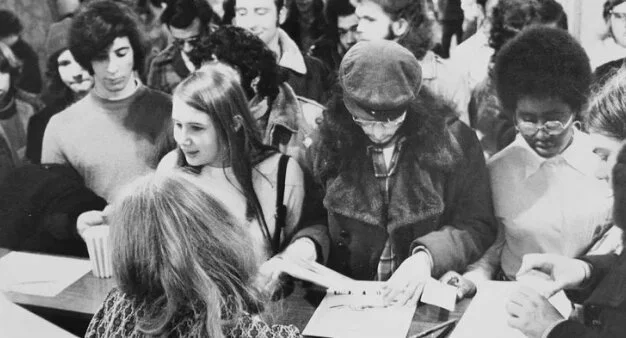
Registration desk at the first Star Trek convention in January 1972.
Darkened by the looming shadow of major media and TV conglomerates, fandom spaces are shifting. Now prone to becoming the butt of a title line, like “Girls Who Love Boys Who Love Boys,” what was once for those who spoke in a carefully coded secret language has become a joke and a marketing tactic for the masses. This is not all ill-received; company-produced fan edits shared on their social media have had their share of the limelight, highlighted well by the absurdities posted on TikTok accounts like HBO Max Nordic. Though entertaining, the marketing tactic defeats the purpose of what these videos and spaces once were — a shared conversation about fans’ favorite media pieces, centered on honesty and enjoyment, grounded in passion rather than greed.
Fangirls are forged in fire; the bylaws are sketched in the bones of those who have been raised within these spaces. There is an unwritten legislation of decorum, respect, and privacy, rules that are impossible to learn in a day and tricky to grasp as an outsider. Companies and networks are, by definition, outsiders to these spaces. They are not fans; they are not sharing or consuming fan content that is rooted in a sense of community and love for the media at hand. They are uncaring about breaking the secret rules of propriety and the privacy implicit in these spaces, resulting in brutal internet clashes where the home turf belongs to the fans.
Betches and The Vulture posted articles that have been central in this war on fangirls. The Betches article, before its removal due to backlash, was titled “Exposing the Kinky Underbelly of The Pitt Fandom.” It focused on the world of fanfiction and the art of shipping (romantically pairing two characters) and portrayed fanfiction participants as solely interested in the sexual. The Vulture article about the series Heated Rivalry sparked similar criticism when it featured fanfictions by linking to stories without consulting the authors. The articles’ points of view upset many fans who felt that their work had been reduced to the debased and used shame as a tool to degrade women who indulge in the subject, in contrast to what the spaces are intended to be. Fanfiction has always been home to the queer, the poor, and the odd. Neither article addresses these issues; instead, they isolate and anger fans in an attempt to gain clicks. The Vulture and its paywall heightened the debate around these articles, and when The Gay Times followed suit, the outcry grew even louder.
Paywall on Vulture’s “Girls Who Love Boys Who Love Boys” article, where fanfiction is hyperlinked.
The paywalls on these articles combat what fanfiction is meant to be in its origins, free and unrestricted, with most fanfiction sites having no required subscriptions or payments or restrictions. Wattpad has been the antithesis and ultimate traitor: once a successful fanfiction site and then app, it has, in recent years, transitioned to original and paid content. The app promotes stories to become books and movies, capitalizing on what was once free fan space. None of the movies have been wildly successful, with titles like After, Kissing Is the Easy Part, and Sidelined: The QB and Me. These articles and apps break a fundamental rule of the free creative expression fandom spaces are dependent on. Thus far, attempting to do so has produced less-than-mediocre results, with nothing good coming from once-sacred walls being breached by greed.
This breach has had uncomfortable consequences for those who produce content, and they have been vocal about the boundary-breaking. In an interview with BuzzFeed UK, two leading actors of The Pitt, Noah Wyle and Katherine LaNasa, responded to popular X posts with lighthearted responses. Still, the fans were flabbergasted when raunchy fan art was presented to the pair. The interaction left a sour taste in many mouths despite its positive nature, and the artist themselves spoke on X about not being asked beforehand, citing that the piece had not been made with the actors in mind but with fans who had a shared ideology. This was a sentiment matched by fellow The Pitt actor Gerran Howell in an interview with Hollywood Reporter, where he said, “I try to keep away from the stuff that is obviously for the fans to appreciate… It is for them.” The response received high praise online.
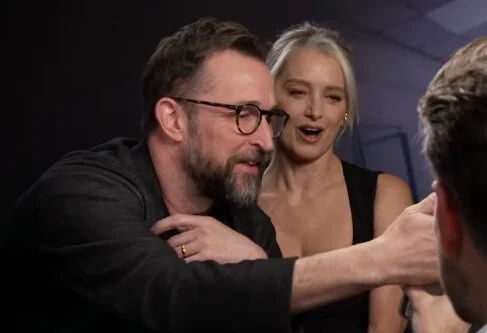
Noah Wyle and Katherine LaNasa reacting to a fan art with Buzzfeed UK.
The disconnect between the media and fandom is the purpose of fandom and fan spaces. Media naysayers don’t seem to grasp that fans are not delusional, they are creative. What is produced by fans is not necessarily what they believe to be true to canon, nor is it what they want to be canon to the media they are consuming. It is to give other fans a chance to explore possibilities within their favorite spaces. It is about community and creativity, and at the heart of it, fun. The media’s assessment of it is reductive and insulting, and it seems fangirls won't take the critique without a fight. Fandom spaces are not going anywhere, nor is the growing contention around them and their portrayals, and in a world that is increasingly obsessed with profits and streamlining what once was creative, fan spaces and fangirls are more important than ever.
About the author: Stella is a Junior Humanities Major from Newberg, Oregon. She wastes her free time watching too many TV shows and movies. Her favorite things include comic books, the internet, and getting emotional over women’s art.
Sources:
Cover Source:
Androniki Christodoulou Otaku Spaces Photo Collection
Photo Sources:
Yahoo News: Star Trek Conventions
Buzzfeed UK Interview with Noah Wyle and Katherine LaNasa
Merriam Webster’s Definition of Fanfiction
Fanspeak: The Brief Origins Of Fanfiction
Heated Rivalry and Why So Many Women Love Gay Male Romance
Buzzfeed UK interview with Noah Wyle and Katherine LaNasa