
The American Diner and Booth Seating in the World of Cinema
If you were dining in a restaurant and were presented with two different choices of seating, a regular table with chairs, or booth style seating, which would you choose?
When going out to lunch for a friend's birthday recently, our party was presented with a choice between the two styles of seating, to which we decided that we would much prefer booth seating. The choice seemed so obvious. But just how does the comfort and functionality of booth seating work to create an environment of intimacy, seclusion or romance? Of course, the emotional environment of a dining experience is determined by whom you are dining with, the circumstance of the outing, the time of day, etc. What I am investigating is how the structure of booth seating plays an integral role in the “vibe curation” of a dining experience, and furthermore, how the structure of the booth creates moods in the cinematic world.
A Brief History on Diners in America
The architectural style of the American diner was adapted from the design of traincars. The curvature of the building and booth style seating are both train car features which made their way into the stationary and sit-down diner. The diner is a representation of the Industrial revolution and the feats of American innovation. What this transition did was take the functionality and maximization of a small space and transformed that close proximity and sense of comfort to a larger space.
The classic American diner elements include booth seating, checkered flooring, circular light fixtures, juke boxes, and brightly colored signature with eye-catching fonts. The style of the American diner is actually an amalgamation of multiple different eras combining the 1920’s with the invention of the steam engine, the 1940’s with the creation and mass production of the automobile and drive-ins, and the Jetson’s style fonts inspired by the 1960’s desire for space travel.
One important style of architecture is called Googie architecture, defined by MasterClass in their article, “Guide to Googie Architecture: 13 Iconic Googie Buildings”:
Googie is a futurist style of architecture that came of age in the mid-twentieth century in the United States, particularly Los Angeles and the surrounding suburbs in Southern California. Googie buildings incorporate strong geometric shapes, upswept roofs, the suggestion of motion, and a mixture of materials ranging from steel to glass to craggy boulders.
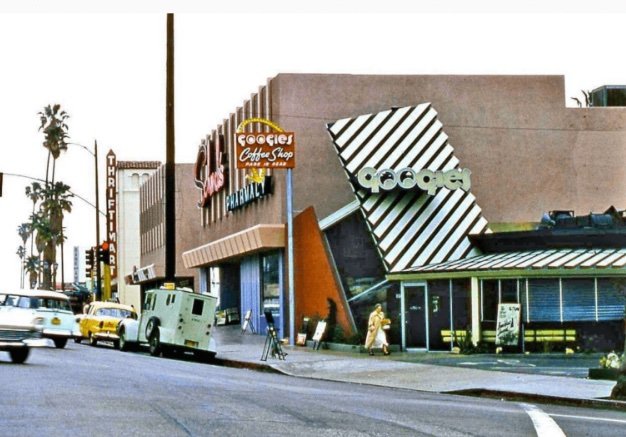
Googie’s Coffee Shop by John Lautner in Los Angeles, CA
In a youtube video by Architectural Digest titled “Architect Breaks Down Why All American Diners Look Like That | Architectural Digest”, architect Michael Wyetzner notes that, “The Googie style, once a vision of the future, became a thing of the past.”
One of the only elements that survived from the style of the retro diner is booth style seating, now (intentionally or unintentionally) an homage to American innovation. Represented in the creative media of American filmmakers, now serving as historical records of the transformation of American architecture.
I will admit that while conducting research for this topic I felt somewhat silly writing about something so mundane, but I stopped myself from indulging in such thoughts, reminding myself that we can learn something from everything, even seemingly mundane topics. It is my guess that the comfort and safety that booth seating provides is overlooked because booth seating appears in a wide variety of spaces. It is no longer associated with one particular scene or style. For example, there are booths in Denny's or in your local diner, but there is also booth seating in fine dining restaurants. What is constant about booth seating is that you can always depend on it to be a free and non-confining space to sit and enjoy your meal.
For author Erika Houle, her L-shaped oasis provides dependable comfort regardless of location. In a fun and refreshingly unique article titled “The restaurant booth is the equivalent of entering a life behind the scenes” Houle says that:
“A booth is where restaurant regulars are born, where out-of-towners can find a taste of home, where romantics dream up first dates launching lifelong partnerships — however noisy or filled with distractions the atmosphere becomes, a booth remains a sanctuary.”
The sense of normalcy that the American style diner provides bleeds red, white, and blue into the cinema of the western world. The inclusion is so seamless that it's likely that you never even stopped to think about it. In popular American sitcoms like Seinfeld or Gilmore Girls there is a diner that exists as a grounding secondary space for characters to convene over a cup of coffee. In movies like When Harry Met Sally, Pulp Fiction and Paris, Texas the American diner, especially with the presence of the booth is used as an important framing device as well as an agent in the creation of intimacy. In a movie like When Harry Met Sally the booth functions to create romantic intimacy and in a movie like Pulp Fiction the booth is used to create a kind of private space for characters to devise nefarious plans.
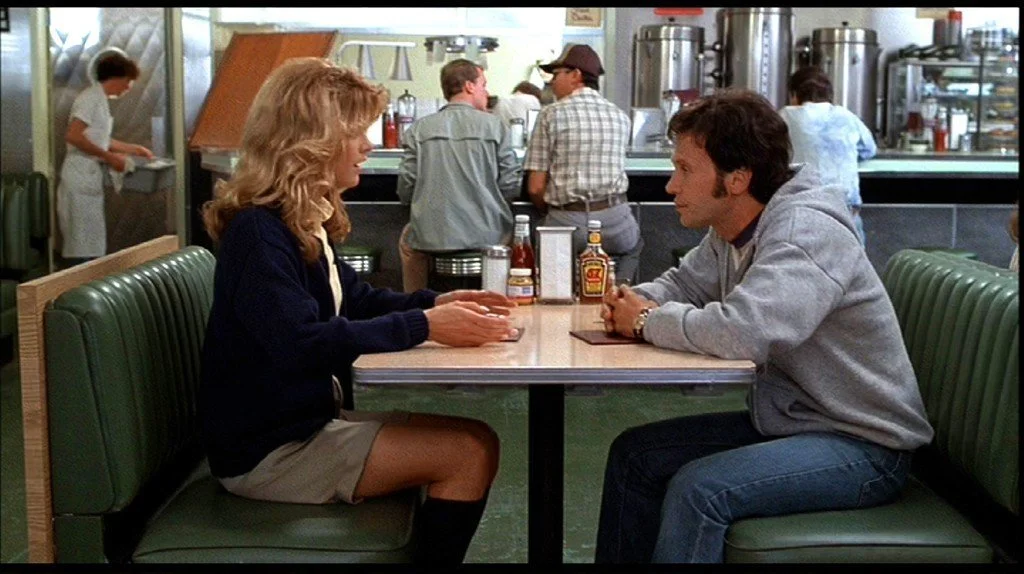
Still from Rob Reiner’s When Harry Met Sally
In David Lynch’s work the American diner is a constant. In Twin Peaks and in Blue Velvet the diner sequences offer a sense of normalcy, familiarity, and comfort that can be translated through the screen. It is possible that as an American director the inclusion of diners in his work reflects his own love for diners. It is known that one of Lynch’s most frequented restaurants was a classic American diner called Bob’s Big Boy in Burbank California.
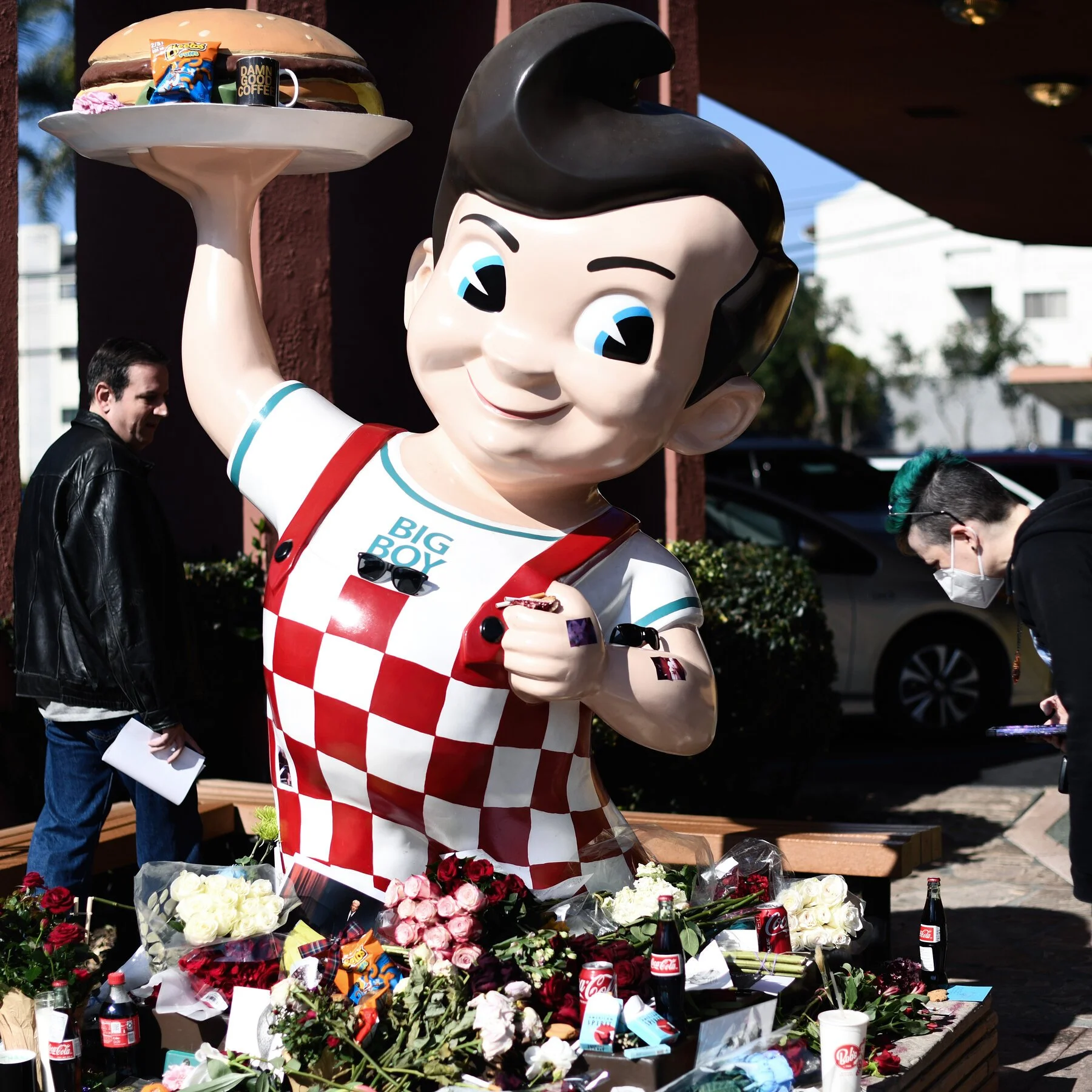
David Lynch Memorial at Bob’s Big Boy in Burbank, California
What I have decidedly discovered about the effect of booth seating in the world of cinema is that the framing of it forces proximity and closeness, which reflects the intimate feeling of being close to the people you choose to dine with.
The American Diner is a space of comfort and closeness. The dependable menu that will always have your trusty favorites, the smell of coffee brewing, and the waitress that calls you “hun”. There is a distinctly American charm that is expected when you sit down to eat in the leather booth of a diner. And even when the style of the booth is removed from the context of the traditional Americana diner, the amount of comfort remains.
If you are interested I have included a letterbox list from user @deeceered that showcases films that have diner scenes! The list: https://letterboxd.com/deeceethered/list/movies-with-diner-scenes/
Sources:
https://www.youtube.com/watch?si=IGonDP1g_DRFlXch&v=fYSfG_6Sv5g&feature=youtu.be
https://bobs.net/pages/hall-of-fame-david-lynch
https://www.masterclass.com/articles/guide-to-googie-architecture#4zZDzq1vTi6xXeyosotBTe
https://www.nytimes.com/2025/01/24/dining/david-lynch-bobs-big-boy.html
About the author: Nahla Wilson is a senior majoring in English with a minor in digital humanities. Her hometown is Austin, Texas. In her free time she enjoys hiking, watercolor, trying new food, and finding any excuse to dress up!