
Privatization of the Past: From Museum Halls to Met Balls
In a global context of imperialism and colonisation, historical objects have been a source of controversy for generations. Often removed from their original cultures and placed in museums or private collections, these items frequently spark debate over rightful ownership.
Museums are seen as safer than private collections, but they still face controversies. The British Museum, for example, is infamous for refusing to return hundreds of items acquired during the British Empire. Other museums, such as the Louvre and the Metropolitan Museum of Art, face similar criticism. On the other side of the coin is the age-old phenomenon of private collections, in which are items held by individuals or companies for commercial or personal use and appreciation. These collections garner flak for their lack of proper preservation and are a long-standing tradition of elites using historical objects to project power and status. This dynamic commodifies historical artifacts, turning them into symbols of competition and power rather than objects to be studied for their cultural context.
A recent, high-profile example of this occurred at the 2022 Met Gala, when Kim Kardashian wore Marilyn Monroe’s dress from Monroe's performance at President John F. Kennedy’s birthday. Kardashian rented the dress from Ripley's Believe It or Not, a for-profit private collection. As a piece of celebrity fashion, there is less controversy with its role as a private acquisition. However, the renting of the object for profit, and the subsequent degradation, sparked major controversy. Many argued that Monroe’s dress, made to fit her exact proportions, a body that was both sexualized and revered, had no business on another woman’s body. Monroe was a tragic star who lacked agency throughout her career; little was hers alone. This dress was one of the few things that was.
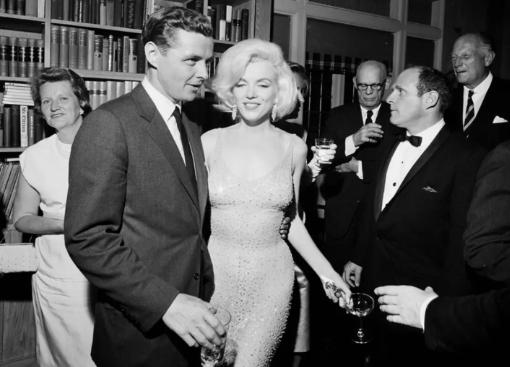
Marilyn Monroe at John F. Kennedy’s 45th Birthday at Madison Square Garden, 1962
Kardashian said nothing of the star’s tragic life or the sexualization of the body she was trying to emulate, instead making a spectacle of her attempts. She posted her aggressive diet to fit into the dress, as if starving to fit into a dress was a point of pride rather than an egregious attempt to commodify a historic piece of fashion. This was an unsurprising move from a celebrity who often sparks controversy with her body, but no less unsettling. Her efforts were for nought, as by the time of the Met, the dress still did not fit. She wore it anyway.

Kim Kardashian in Marilyn Monroe’s dress, Met Gala 2022
After Kardashian wore the dress, even unzipped, it was notably degraded. In the wake of the matter, the International Council of Museums commented that “historic garments should not be worn by anybody, public or private figures.” The moment marks a point of contention and change. Before, controversy around historical objects had lived in museum halls. Now, they were front and center on red carpets. Once Hollywood sinks its claws into a new commodity, it is hard for anything involved to come out unmarred.
The same Met Gala saw Emma Chamberlain donning The Maharaja of Patiala’s Diamond Choker, which resides in Cartier’s collection. The Patiala necklace was commissioned by the Maharaja Bhupinder Singh of Patiala in 1928, who had his obscenely large diamonds set in a ceremonial piece of jewelry that took Cartier over 3 years to complete. The choker Chamberlain wore was only a part of the original. Cartier, who loaned Chamberlain the necklace, had come to buy the piece in an auction in 1988, years after it had gone “mysteriously missing” from British Imperial collections in 1948. Once a revered piece of jewelry belonging to the Indian royal family, it was used by a French company for profit and advertising on the neck of a white YouTuber.

Emma Chamberlain wearing The Maharaja of Patiala’s Diamond Choker, Met Gala 2022
To add insult to injury, in 2025, Punjabi star Diljit Dosanjh dedicated his Met Gala look to Maharaja Bhupinder Singh and requested the piece previously worn by Chamberlain. He was denied on claims that, for preservation and exhibition purposes, Cartier could not loan him the necklace. This statement raised eyebrows. What had changed from 2022, when Chamberlain wore the necklace? The answer is likely nothing, but Dosanjh wearing the necklace in the dedication may have sparked a conversation Cartier did not want to be a part of – one that questioned the legitimacy of them owning such an iconic piece of Indian culture. Chamberlain, a white woman, was unlikely to speak out or cause trouble for the brand. The same could not be said for the attention that would have come had Diljit worn it. The privatization of history thus becomes not a conversation about the origins and impact of these pieces, but instead a breeding ground for agendas and profit.

Diljit Dosanjh dressed by designer Prabal Gurung, Met Gala 2025
Cartier’s controversies continued into 2026, where they were present at the scene of another crime: the press run of Emerald Fennel’s “Wuthering Heights.” The crime in question? Margot Robbie’s questionable fashion choices of dubious origins. On this press run, she wore the Taj Mahal Diamond, though onlookers would not know it. She spent the run boasting about wearing Elizabeth Taylor’s diamond, as if that was the necklace's origin of fame.
The questionable nature of this accessory is only deepened by the premiere she wore it to. Emily Brontë’s novel “Wuthering Heights” focuses on a tragic tale of ill-fated romance, set within a society rooted in classism and racism that twists into an exploration of the generational trauma and abuse this system promotes.Fennel’s film is under fire for removing the heart from this story, whitewashing the cast, and sexualizing characters who are marked by their strength in the face of abuse. This makes Robbie’s parading around of the historical piece of Indian history as a piece of British fame and call of celebrity all the more disheartening.

Margot Robbie wearing the Taj Mahal Diamond at the Los Angeles Wuthering Heights Premiere, 2026
The necklace was made for the Empress Nur Jahan, commissioned by her husband, Mughal Emperor Jahangir, in the 17th century, making it nearly 400 years old. After her death, it was passed to their son Shah Jahan, who gave it to his favorite wife, Mumtaz Mahal, the inspiration for the Taj Mahal. The piece is opulent and a marker of the love shared between generations of monarchy, marked with the words “Love is Everlasting” in Parsee. It is unclear what happened to the diamond after Shah Jahan’s reign; it is assumed to have been stolen, along with most other valuables, when the Mughal Empire fell at the beginning of British colonization of India, but its reappearance is well documented.
Somehow, the diamond came into the hands of Cartier in the 20th century. They redesigned the necklace, taking away the original silk and styling it to Western standards. Cartier gifted it to actress Elizabeth Taylor at the request of her husband Richard Burton in 1972 for her birthday. Taylor’s ownership of the necklace only cements the long-standing, star-studded, elite practice of owning historical objects. With this story, we again see a piece of celebration, love and dedication set in the hands of imperial powers that pass historical pieces around for fame and profit. Today, the necklace is more revered for belonging to Elizabeth Taylor than as the 400-year-old gesture of love that it is.
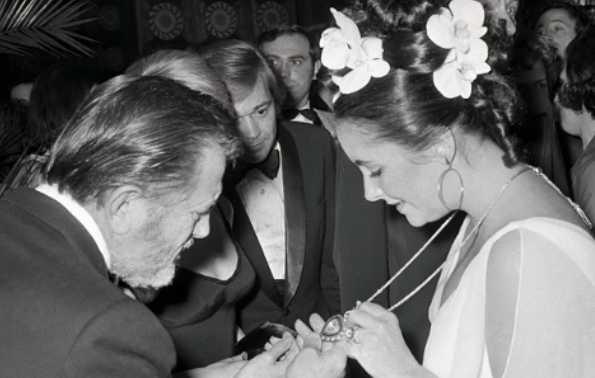
Elizabeth Taylor showing off the Taj Mahal Diamond at her 40th Birthday Party, 1972
The debate around the appropriate use and appreciation of historical pieces is not one that is likely to end soon, but indisputably, Hollywood sinking its teeth into these antiquities has shaped the way these conversations will be had moving forward. This use of history as status is not new nor shocking, but it revives the question of what history is, who it is for, and how it should be appreciated.
Sources:
The True Stories of 10 of the Most Disputed Objects at the British Museum
Ripley’s Believe It or Not Museum: Unveiling the World’s Most Extraordinary Oddities and Wonders
Forbes: The Kim Kardashian ‘Marilyn Monroe Dress’ Controversy, Explained
The History of The Taj Mahal Diamond Worn by Margot Robbie
Cover Image:
Curiosmus: Lost Ancient Knowledge: 7 Unexplained Artifacts That Challenge History
Imbedded Images:
Los Angeles Times: They called it! Kim Kardashian really did damage that iconic Marilyn Monroe dress
Diamond Jewelry Hall of Fame: Revisiting Emma Chamberlain’s 2022 Met Gala Diamonds
Vogue Arabia: The Story Behind Elizabeth Taylor’s Legendary Necklace, as Worn by Margot Robbie

About the Author
Stella Van Goor is a Junior studying Art History and Humanities. She is from Newberg Oregon. Stella loves comic books, Star Wars, Game of Thrones, and spends her free time watching too many TV shows and movies.